Water grows by about 9 percent when it turns to ice, and Penn State Extension notes that the force behind that extra volume is enough to crack a wooden or plastic rain barrel, especially one that is full or nearly full. The same physics works on a garden hose, on the copper tube inside an outdoor faucet, and on the valves of an in-ground sprinkler system, which Colorado State University Extension says will break pipes, fittings, valves, and sprinkler heads when water freezes inside them. None of that damage announces itself in November. A hose left on a faucet looks fine until a hard freeze, and a split pipe inside a wall may not show itself until someone turns the water back on in spring. Shutting down your outdoor water takes no new products, and it gives the barrel, the hose, and the pipe another season instead of a trip to the curb. The job comes down to three places, in this order: the hose connections, the rain barrel, and any sprinkler or drip system.
Find Your Local Freeze Date First
The date that matters is your town's, not your region's. NOAA's National Centers for Environmental Information publishes maps of the median first fall freeze, built from its 1991-2020 U.S. Climate Normals. A freeze there means 32°F or below over a widespread area, and "median" means the freeze arrived on or before the mapped date in five years out of 10. NCEI's regional summary puts that date between mid-September and early October across much of the Midwest and Northeast, in early October in Virginia, later and later as you move south toward December, and not until at least December in most of California and southern Arizona away from high elevations. Cities and shorelines freeze later than rural inland spots, so the regional range is only a starting point.
For rain barrels there is a stricter yardstick. Penn State Extension recommends emptying and detaching the barrel before the median first hard freeze date for your locality, which it defines as temperatures below 28°F for an extended period. In Pennsylvania alone that date runs from early October in some northern counties to late November around Philadelphia, which shows how far the deadline can move within a single state. If your date has already passed, today's forecast low is your deadline. If it has not, pick a day now rather than the night the temperature drops.
Do not count on a weather alert to prompt you. The National Weather Service says it issues Freeze Watches in the autumn only until the end of the growing season, so the alerts can stop weeks before your pipes are out of danger. And if you live somewhere that rarely freezes, the list below is mostly not for you: NCEI notes that parts of Florida might not see a freeze every year and that the Florida Keys have not recorded freezing temperatures.
Hoses Come Off First, Even on a "Frost-Free" Faucet
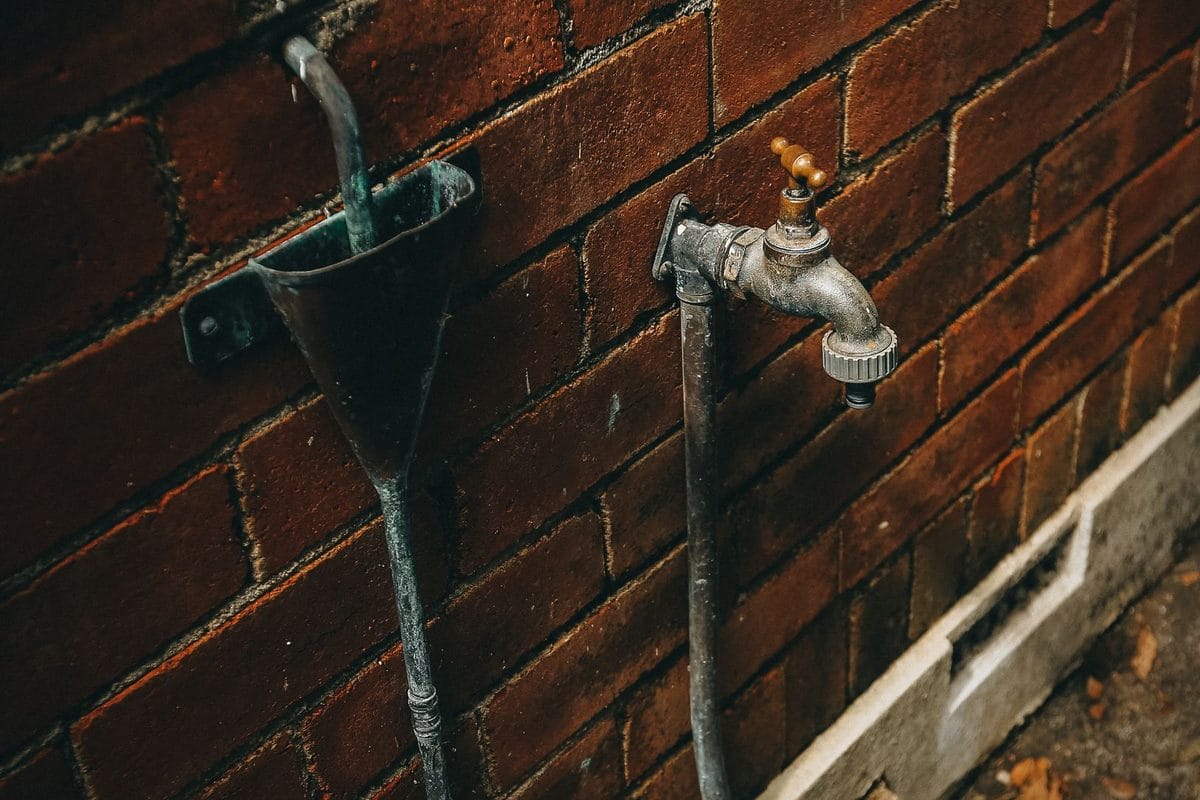
A frost-free faucet is not a freeze-proof one. Its valve sits at the end of a long stem, inside the heated part of the wall, so the section of pipe outside stays empty when the handle is off. But Arrowhead Brass, which makes these wall hydrants, states in its installation and repair guide that a hose, a Y splitter, an irrigation timer, or an add-on backflow preventer left on the spout keeps water trapped inside the faucet. When cold weather arrives, that water freezes upward toward the back of the faucet, pressure builds, and the copper tube bursts, which causes leaks inside the wall. The same guide says the faucet only drains if it is installed at a slight downward angle toward the spout, and that a unit installed level or tilted up can hold water and freeze even with the hose off. A small level laid along the spout tells you which kind you have.
- Disconnect every hose, splitter, timer, and spray nozzle from every outdoor faucet, including the one behind the shrubs that nobody has touched since June.
- Drain each hose by lifting one end, coil it loosely, and hang it in the garage or basement, because a hose with ice in it can split along its length and a split hose has no second life.
- If the pipe feeding an outdoor faucet has its own shutoff valve inside the house, close that valve, then open the outdoor faucet so the short run of pipe behind it can drain. The State of Michigan's frozen-pipe prevention page recommends this shutoff-and-drain approach where it is practical.
A faucet that tilts the wrong way is a plumber's job, not a weekend project, and until it is fixed the safest habit is to treat it as closed for the season, with its interior valve shut if it has one.
The Rain Barrel: Use It, Drain It, Flip It
Empty the barrel before the first hard freeze, not after it.
Penn State Extension adds that even when the ice does not crack the barrel, it can sit there all winter, shrinking its capacity for new runoff and making it harder to drain. Before you drain it, put the water to work. University of Illinois Extension recommends watering newly fall-planted trees, shrubs, and perennials late into the season, since they have had less time than spring plantings to build roots, and paying particular attention to evergreens and shallow-rooted trees such as birches and maples. Those recommendations come with conditions that are worth keeping. Check the soil first by digging 4 to 6 inches down near the drip line and water only if it is dry, water only when the air is above 40°F, and stop once the ground freezes, because frozen soil cannot take up water. Illinois suggests weekly watering for new plantings and monthly for established trees during dry stretches, applied slowly at the drip line rather than against the trunk. For a small shrub, its horticulture educator suggests drilling a 1/8-inch hole in the bottom of a 5-gallon bucket, filling it from the barrel, and letting it seep.
Whatever is left gets drained on purpose, following the steps Rutgers Cooperative Extension and Penn State both describe.
- Open the spigot and leave it open for the winter, with a length of hose carrying the water away from your foundation.
- Disconnect the diverter or downspout from the barrel, then put the downspout back to ground level with a short piece of downspout and an elbow so roof water runs away from the house instead of splashing onto walls or a walkway where it becomes a slippery hazard.
- Store the barrel indoors if you have room. If it stays outside, turn it upside down or cover the inlet securely, so rain and snow cannot refill it, and strap it to a post, because an empty plastic barrel will wander across the yard in the first good wind.
- Use the downtime to scoop out sediment, leaves, and sticks, and replace any leaky valve, torn screen, or cracked inlet hose before they cost you water next summer.
Mark the spring restart now. Penn State advises waiting until the median last hard freeze date has passed before reconnecting, and in Pennsylvania that ranges from mid-March in the southeast to early May in a few north-central counties. Write that date on the barrel with a permanent marker.
Sprinklers and Drip Lines: Where DIY Stops
Colorado State's guidance is blunt: do not trust manual or automatic drain valves, and blow the system out with compressed air. Buried pipe shifts over the years, there is no way to see whether the lines emptied, and systems with electric valves cannot be cleared any other way, because water sits on top of the valve diaphragm. Air volume matters as much as pressure. CSU gives 40 to 80 psi as the ideal range, with 80 psi as the ceiling for rigid PVC and 50 psi for flexible polyethylene pipe, and it says to run one zone at a time, because too much velocity can heat the pipe and fittings to the point of melting, and too much pressure will blow the sprinkler nozzles off. It also warns that pressure vacuum breaker and reduced-pressure backflow devices must never be blown out with compressed air, since the rubber seals inside can melt; those get drained by hand, with their valves left partly open for the winter. The blowout connects to a fitting downstream of the backflow device, and if yours has none, one has to be added first.
That is a lot of ways for a chore meant to prevent damage to cause it. Unless you already own a compressor sized to your zones and know which backflow device you have, hire an irrigation contractor for this one and book the visit before the freeze rather than after it. Drip lines fed from a hose faucet are simpler: they fall under the hose step above, because Arrowhead lists irrigation timers among the devices that trap water, so take the timer inside with the hose.
What a Missed Step Costs
The Michigan Committee for Severe Weather Awareness estimates that a quarter-million homes are damaged by frozen water pipes each winter, according to the state's preparedness page, which also says an eighth-inch crack can leak up to 250 gallons of water a day. That figure is about pipe cracks in general, not outdoor faucets specifically, and the amount that escapes depends on the crack and the water pressure. Still, 250 gallons is as much as five full 50-gallon rain barrels a day, running inside a wall where nobody is watching the meter. Water that fell on your roof costs nothing, while treated tap water pumped through a burst pipe, plus the drywall, pipe, and fittings that end up in a dumpster, is a poor way to end the season.
Check tonight's forecast low before you decide this can wait. At 32°F or colder the hoses and faucets come first, and at 28°F an unemptied barrel is the next job on the list.