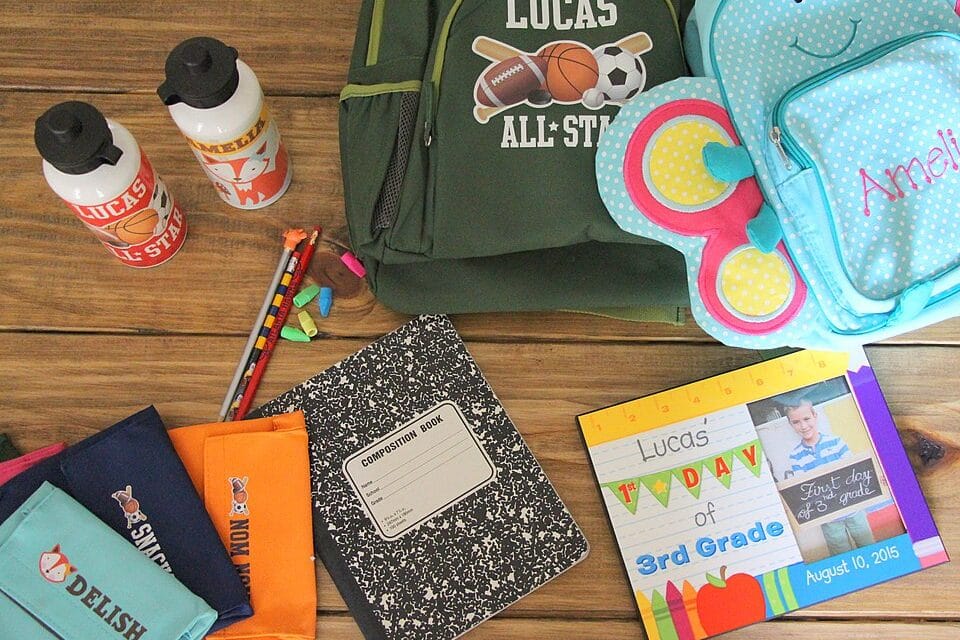
Walk into any Target or Walmart during the last week of July and you'll see it: a cart half-full of folders and glue sticks, a backpack that costs more than the shoes it's paired with, and a kid tugging a sleeve to insist the old one is "for babies." The back-to-school aisle is where American household spending and American household waste collide hardest every year. The National Retail Federation has pegged average family spending on K-12 supplies well past $600 annually for a while now, and a good chunk of that never makes it past Halloween. Plastic pencil cases crack. Backpack zippers blow out by Thanksgiving. Last year's barely-used folders get pitched straight into the trash because nobody thought to check the closet first, and the same $40 in supplies gets bought all over again a year later.
None of that is inevitable. Cutting waste out of back-to-school shopping isn't about denying kids anything new or turning the first day of school into a lecture on landfills — it's about spending the same $400 to $600 differently, on fewer things that last longer, timed to the weekends when a state picks up part of the tab.
Start With What's Already in the House
Before any list gets typed into a search bar, empty every backpack, drawer, and bin from last spring. Half-used notebooks are still notebooks. A backpack with one worn strap can often be repaired at a local shoe repair shop for $8 to $15, instead of replaced outright for $45. Binders and folders survive multiple school years if a kid isn't actively destroying them for sport, and most supply lists don't actually require anything brand new — the line item says "one 1-inch binder," not "one 1-inch binder purchased this month."
Color-coding by subject rather than by brand stretches what's already in the house even further. If last year's math folder was green and this year's teacher wants red, swap the label instead of the folder. A $0.50 sticker beats a $2 folder every time, and it keeps three-ring binders with plenty of life left out of the donation pile a full year early.
The Secondhand Advantage: Clothes, Backpacks, and the Stuff Kids Outgrow Fastest
Clothing and backpacks are where secondhand shopping earns its keep, because kids outgrow both faster than they wear them out. Goodwill and local thrift shops routinely carry backpacks, lunch boxes, and uniform-style clothing for a fraction of retail. A $60 backpack at Target often shows up at Goodwill for $8 to $12 in near-new condition, especially in August, when families donate last year's model on their way to buy this year's. ThredUp's back-to-school inventory swells every July with kids' clothing sorted by size and season. Facebook Marketplace groups organized by school district move even faster: a parent posts "outgrown these, size 8, $10 for the bag" the week before the first bell, and pickup is a five-minute drive across town. None of it requires haggling or waiting — most of these listings sell within a day during peak back-to-school weeks.
Buy secondhand for the categories kids grow out of within a single school year — jeans, coats, sneakers, backpacks — and save new purchases for items that get used daily until they physically fail, like lunch containers and a graphing calculator. That split matters more than any single purchase decision, because it separates spending on growth from spending on durability.
Buying Supplies That Make It to June
Cheap plastic pencil cases and dollar-bin pens are false economy dressed up as a bargain. A $1 pack of ten pens that die by October costs more per semester than one $8 refillable pen with $0.50 ink cartridges, and it produces ten pieces of plastic waste instead of one pen body that lasts four years. The same logic applies to lunch gear: a stainless steel lunchbox from a brand like PlanetBox or Bentgo runs $30 to $45 and survives being dropped, microwaved near, and thrown across a cafeteria table for years. The $6 insulated bag from the school-supplies endcap, by contrast, usually needs replacing by winter break.
Backpacks are the single biggest durability decision on the whole list. A $25 backpack with thin nylon seams and no real warranty is a backpack you'll buy again in January when the zipper fails. A $70 to $90 backpack from a brand like L.L.Bean or JanSport, backed by a multi-year warranty, gets repaired or replaced free instead of thrown out. Cloth pencil pouches, metal binder rings, and refillable glue sticks all follow the same pattern: spend once on the version built to be reused, not the version built to be replaced.
Where cheap plastic still wins
Not everything on the list deserves an upgrade. Crayons, glue sticks that get used up rather than broken, and the cheap protractor a kid touches twice a year for geometry aren't worth agonizing over. Buy the basic version, use it up, and put the durability budget toward whatever gets handled every single day instead.
Time Purchases to Your State's Tax-Free Weekend
Fourteen states are running back-to-school sales tax holidays in 2026, and lining up big purchases with the right dates saves real money on top of shopping secondhand. Texas holds its tax-free weekend August 7 through 9, exempting clothing, footwear, and school supplies priced under $100 per item. Buy two $90 backpacks on the same receipt and both are exempt, since the cap applies per item, not per order. Ohio runs the same August 7 through 9 window, but with tighter caps: clothing up to $75 and school supplies up to $20 per item, a detail worth knowing before loading a cart with $40 lunchboxes expecting them to qualify. Missouri's holiday also lands on August 7 through 9 and additionally covers computers, software, and graphing calculators within state price limits, which matters a lot if a laptop is on this year's list. Check the exact caps on your state comptroller's website before checkout, since a single item over the line becomes fully taxable rather than partially exempt.
Florida is the outlier worth planning a whole shopping trip around. Its approach is different, and frankly more useful for actual planning. Instead of a single scrambled weekend, its 2026 holiday runs a full month, from July 20 through August 20, covering clothing and bags under $100, school supplies under $50, learning aids under $30, and computers under $1,500. That length gives Florida families room to comparison-shop instead of racing through a three-day window — a real advantage over the sprint-style holidays in Texas and Ohio, and arguably the better model for other states still deciding whether to expand their own.
Packing Lunches Without Filling the Trash Can
A kid who brings a plastic sandwich bag, a juice pouch, and a bag of chips to school every day sends roughly three pieces of single-use packaging toward a landfill, or best case, toward a recycling bin that may not process them anyway. Most school cafeterias aren't equipped to sort film plastic, so the sandwich bag ends up in general trash no matter what symbol is printed on it. Reusable silicone bags, sold in sets of five for $15 to $20, and a divided bento-style container in the $20 to $35 range replace hundreds of disposable bags over a single school year, and they survive dishwasher cycles that plastic baggies obviously can't.
Water is the easier swap. A $15 to $25 insulated bottle beats buying single-serve bottled water or juice pouches on both cost and volume of trash, and most schools now have refill stations built into their water fountains specifically because so many families made this switch over the past several years. (My own kid's school added refill stations two years ago, and the hallway trash cans visibly emptied out faster — nobody planned that as an environmental win, but it turned into one anyway.)
EPA Guidance and School Recycling Programs
The EPA's guidance on school waste management points districts toward one consistent conclusion: source reduction beats recycling, because packaging that never enters the building never needs sorting, hauling, or landfilling in the first place. Some districts have taken this further with formal supply donation programs — end-of-year collection bins for unused notebooks, unopened glue sticks, and barely-used folders, redistributed to families who need them before the next school year even starts. That kind of program can cut new-supply demand for those families to almost nothing.
Not every district runs one of these programs, and that's the honest catch. A family in a well-funded suburban district might have a slick supply-swap system running through the PTA, while a family two towns over has nothing beyond a lost-and-found bin nobody checks. If a school doesn't have a formal program, an informal one works almost as well — a shared bin at pickup, a post in the school's Facebook group in late May asking who wants outgrown supplies before they hit the donation truck. It takes one parent to start it and about a week before other families start relying on it.
Closing Out the Year the Right Way
The waste that back-to-school shopping generates in August is only half the story. The other half happens in June, when backpacks, folders, and half-used supplies get tossed instead of passed along. Donate outgrown backpacks and uniforms to Goodwill or a school-specific swap before the summer clearance rush hits, list working calculators and unopened supplies on Facebook Marketplace or a neighborhood app instead of the trash, and set aside anything with real life left for next year's version of the same kid, one size up. Do that once, and the following August's shopping list gets shorter on its own — not because anyone tried harder, but because less of what got bought last year actually needs replacing.