Walk any suburban street on November 1st and you'll see it: a deflated inflatable pumpkin slumped against the recycling bin, a string of solar spider lights half-buried in wet leaves, a witch's hat that's already lost its shape after one night of dew. None of it is going back in a box for next year. Most of it is going straight in the trash, and by the second week of November, curbside pickup crews across the country are hauling away a season's worth of PVC, polyester, and blister-pack plastic that got exactly one use.
You don't have to opt out of Halloween to fix this. The holiday survives just fine on wood, wax, dried gourds, and clothes that already exist in someone's closet — it did that for decades before vinyl inflatables showed up at Home Depot. What changes is where you shop, how far ahead you plan, and whether you treat the decorations as a one-season prop or a five-year investment.
Why Most Halloween Decor Doesn't Make It to a Second Year
The problem isn't that Halloween decorations are cheap — plenty of them run $40 to $80 at Target or Lowe's for a single inflatable. The problem is what they're made of. Blow-up decorations are almost always unlaminated PVC with a built-in fan, and that combination doesn't age well: the seams crack, the fan motor burns out, or a raccoon finds the thing overnight and that's that. String lights fare a little better, but the cheap $8 sets from the seasonal aisle tend to have one bad bulb take out an entire strand by year two, and there's no replacing it. None of this is designed for a decade of use the way your grandmother's ceramic jack-o'-lantern was.
Costumes have the same issue from a different angle. A licensed character costume from Party City or Spirit Halloween — polyester shell, plastic mask, elastic that's already stretched out — is priced like a one-night rental even though you're buying it outright, usually $25 to $45 for a kid's size. It gets worn for trick-or-treating, maybe a school parade, and then it's too small or too flimsy by the following October. Multiply that by however many kids are in the house and however many years until they stop wanting costumes, and you're looking at a real pile of synthetic fabric that can't be donated in good conscience because it won't survive being worn twice.
Decorations That Actually Last
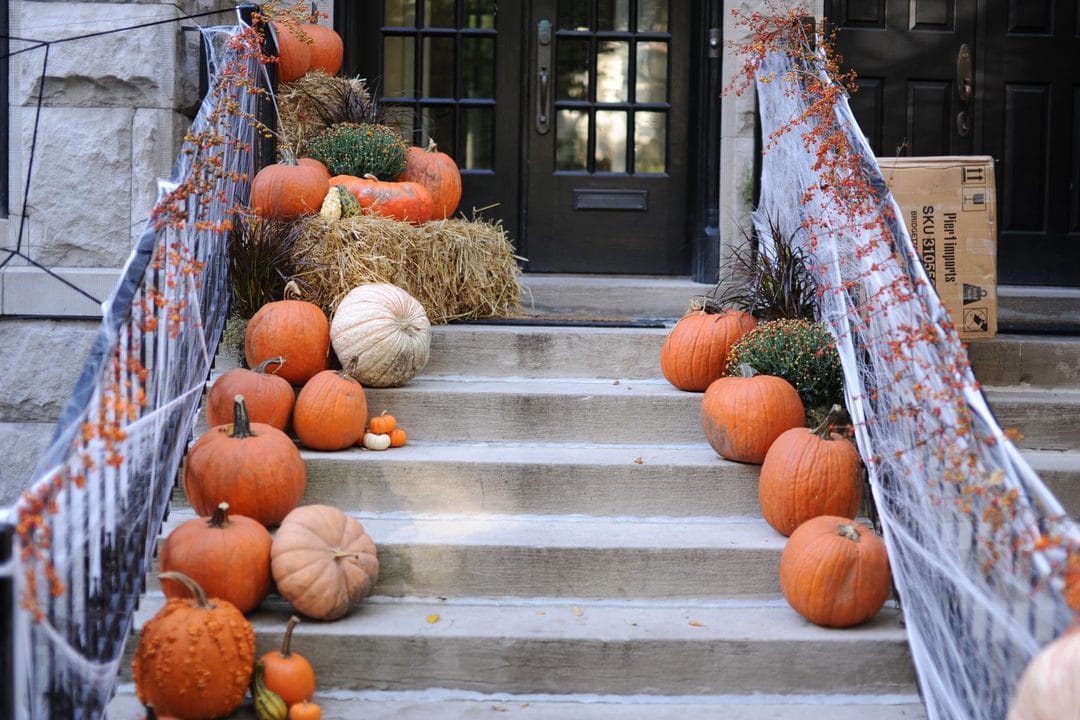
Real pumpkins and gourds are still the best value in the entire Halloween aisle, and nobody talks about this enough. A farm stand or grocery store pumpkin runs $5 to $8 depending on size and region, it's compostable when the season's over, and it looks better on a porch than an inflatable ever will. Buy a few extra small gourds and pie pumpkins for $1 to $3 each and you've got a full porch display for less than one inflatable decoration costs.
- Wooden or cardboard silhouettes (bats, cats, witches on brooms) cut from an old box and painted black hold up for years if you store them flat and dry.
- Cheesecloth "ghosts" made from an old bedsheet or thrifted linen cost nothing and can be washed and reused.
- Battery or solar string lights in plain warm white, rather than novelty shapes, double as porch lighting through the winter holidays — so the $12 to $15 you spend isn't a one-month purchase.
- Hay bales from a garden center ($6 to $10 each) work as a base for pumpkins and compost directly into a garden bed afterward.
If you want the spookier stuff — skeletons, spiders, cobweb netting — buy it once, in a material that isn't going to degrade, and store it properly. A full-size plastic skeleton from Home Depot or Costco runs $20 to $35, which sounds like more than the disposable version, but it's built to be repositioned every year and the joints don't seize up the way a cheap $10 version will after two seasons in a damp garage. Buy the good skeleton once. Skip the fog machine that needs a new bottle of fluid every year if you're only running it one night.
Building a Costume Without the One-Night Price Tag
Thrift stores beat the costume-shop rack every single year, and it isn't close. Goodwill, Savers, and local thrift shops restock heavily through September as people clear out closets, which means late September is when the best pieces show up — trench coats, old suits, oversized flannel, band t-shirts, anything with texture. A full adult costume assembled from thrifted pieces typically runs $8 to $20 total, compared to $35 to $60 for a boxed costume from Spirit Halloween, and you end up with individual items you can actually keep wearing.
This doesn't work for every costume, and it's worth saying so plainly: a kid who wants to be a specific licensed character — a particular superhero, a particular video game figure — usually can't get that from a thrift rack, and no amount of parental creativity substitutes for the actual thing a seven-year-old has been asking about since August. Buy that one new if you have to. Save the thrifting energy for the pirates, witches, vampires, and generic monsters, which is most costumes most years anyway.
Costume swaps are the other underused option. Ask around the neighborhood, a school parent group, or a local Buy Nothing group on Facebook — kids' costumes barely survive one wearing in terms of fit, since a five-year-old is a different size by the following October, which makes them one of the easiest things to trade for free. A few towns run organized swap events at libraries or community centers in early October; if yours doesn't, a group text with three or four other families does the same job.
Rethinking the Candy Bowl
Individually wrapped candy is close to unavoidable for handing out at the door — nobody wants unwrapped treats from a stranger, and that's a reasonable line to hold. But you can still cut packaging waste on the buying side. Buying the largest bulk bag available (the 200-plus count bags at Costco or Sam's Club) uses noticeably less packaging per piece than a dozen small bags bought separately, and it's cheaper per piece too, usually by $2 to $4 across a full bag.
If you're doing a party bowl instead of door-to-door candy, loose bulk candy from a co-op or bulk bin, scooped into reusable containers, skips the individual wrapper problem entirely. And if you're the house handing out non-candy treats, small items like pencils, stickers, or glow bracelets bought in bulk generate less total plastic than the same number of individually wrapped candies — though it's worth checking the material first, since a lot of "eco" trinket treats are still single-use plastic wearing a green label.
What Happens on November 1st
The real test of whether any of this worked isn't October 31st — it's the first week of November, when the decorations either go back in a labeled bin or straight to the curb. Real pumpkins and gourds go in the compost or yard-waste bin, not the trash; most municipal composting programs take them without issue. Costume pieces that are still wearable go into the donation bag now, while they're clean and in season, rather than getting shoved in a closet until next September when nobody remembers what's in the bag.
Durable decorations — the good skeleton, the wooden silhouettes, the string lights — get one afternoon of proper storage: a labeled bin in the garage or attic, not a loose pile that gets crushed under something else by December. That one afternoon is the entire difference between buying this stuff once and buying it every single October for the rest of your life.