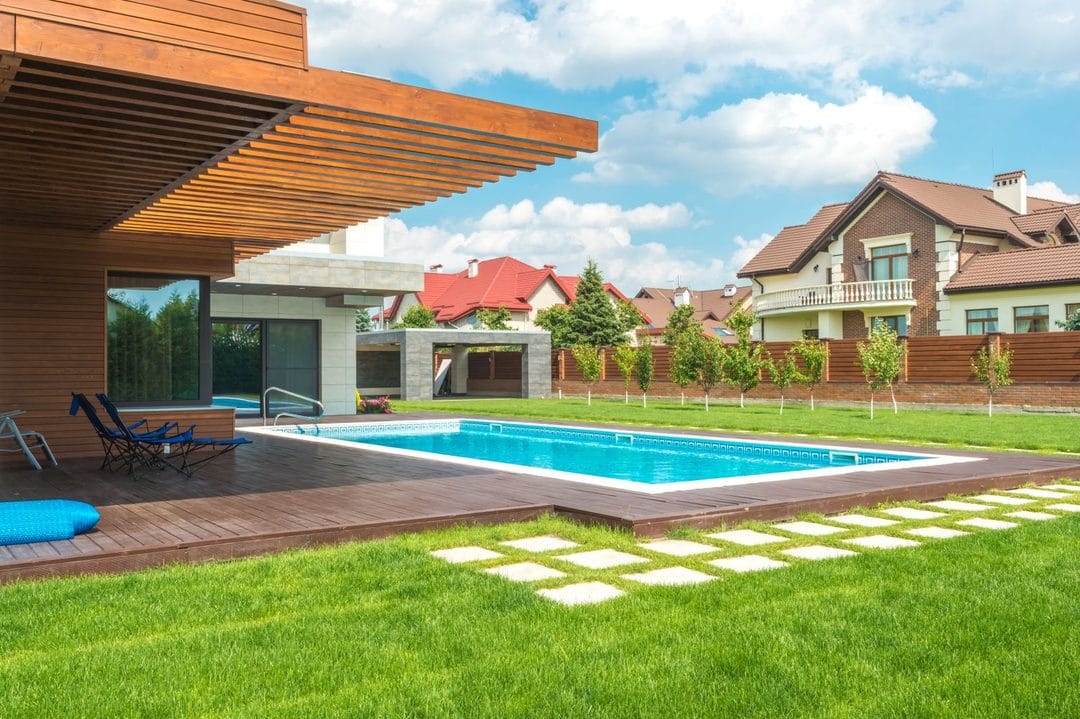
Every July afternoon, somewhere behind a chain-link fence in Phoenix or a cedar privacy fence outside Columbus, a garden hose is running into a pool that's already three inches low. Nobody notices until the water bill arrives in August, thick with a number that used to belong to a much bigger household. The United States has more residential swimming pools than any other country — well over 10 million of them, according to pool industry tracker P.K. Data — and most of what those pools cost the planet happens quietly in the background: a pump running eight hours out of habit, a solar cover left folded in the garage, chlorine tablets dissolving a little faster than the label promises.
None of this requires draining the pool or giving up summer. It requires paying attention to three systems that run themselves once you stop thinking about them: evaporation, pumping, and sanitation. Fix those three, and a backyard pool can go from the neighborhood's biggest utility-bill mystery to one of the more reasonable line items in a July budget.
Where the water actually goes
A standard 16-by-32-foot in-ground pool loses roughly a quarter to half an inch of water to evaporation on a hot, dry, breezy day — more in Arizona or West Texas, less in humid Georgia. Over a full month that adds up to several inches of depth, which for a pool that size can mean 1,000 gallons or more refilled from the hose. Wind is the biggest driver, followed by low humidity and direct sun on an uncovered surface, which is why pools tucked behind windbreaks or shade structures lose noticeably less than ones sitting wide open on a treeless lot.
A pool cover is the single fastest fix, and it isn't close. The Department of Energy estimates that a cover — solar, vinyl, or an automatic slatted system — cuts evaporation by roughly 30 to 50 percent, and because evaporation also carries away heat, a covered pool needs less gas or electricity to stay warm too. A basic solar cover runs $50 to $150 at a pool supply store and pays for itself in avoided water and heating costs within a season for most owners. Automatic covers on a motorized reel cost far more, typically $2,000 to $15,000 installed depending on pool shape, but they get used every single day precisely because rolling one out takes ten seconds instead of the wrestling match a loose solar cover becomes in any wind.
The pump is quietly your biggest electric bill
If evaporation is the slow leak, the pump is the appliance actually showing up on the power bill. Here's the part most pool owners don't know: as of July 2021, federal energy conservation standards from the Department of Energy effectively phased out single-speed pumps for most new in-ground residential installations, pushing the market toward dual-speed and variable-speed models instead. That wasn't a random regulation — a single-speed pump runs at full throttle whether the pool needs full filtration or not, and the DOE calculated the difference was too wasteful to leave unregulated.
A variable-speed pump lets you run filtration at a low, quiet setting most of the day and reserve full speed for vacuuming or backwashing, and the electricity savings are substantial enough that many utilities, including several in Florida and California, still offer rebates of $100 to $300 for owners who replace an old single-speed unit. The Department of Energy's own estimates put typical savings at $300 or more per season for a household that swaps an aging single-speed pump for a variable-speed replacement, which usually costs $800 to $1,600 installed. Pay attention to run time as well as pump type — most residential pools only need six to eight hours of filtration a day in summer, not the round-the-clock cycle some owners inherited from a previous homeowner or a pool-store technician who never adjusted the timer after installation.
Scheduling that run time for early morning or late evening, rather than mid-afternoon, also matters more than most owners realize. Utilities across sun-belt states increasingly bill residential customers on time-of-use rates, where electricity between roughly 4 p.m. and 9 p.m. costs noticeably more than overnight or early-morning power. Running the pump before 9 a.m. or after 9 p.m. doesn't change how many kilowatt-hours it uses, but it can meaningfully change what those kilowatt-hours cost.
Chlorine tablets versus salt: the honest tradeoffs
Chemical waste is the part of pool ownership nobody budgets for until the empty buckets pile up by the garage door. A season of stabilized chlorine tablets for an average pool runs somewhere between $150 and $300, and every one of those buckets — plastic, largely non-recyclable because of chemical residue — ends up in the trash. Saltwater chlorination systems solve the packaging-waste problem by generating chlorine on-site from dissolved salt, which means no tablets, no buckets, and notably softer-feeling water. Installed systems from Pentair or Hayward typically cost $1,500 to $2,500, and the salt cell itself — the part that actually does the electrolysis — needs replacing every three to five years at $700 to $1,000.
Salt systems aren't automatically the greener choice for every pool, and this is where a lot of well-meaning advice oversimplifies. They use more electricity than a simple tablet feeder, since the cell runs an electrical current continuously, and the salt itself has to go somewhere eventually if a pool is drained — it isn't something a storm drain or garden bed should ever receive. For an owner already running an efficient variable-speed pump, the reduced plastic waste and lower ongoing chemical purchases still tip the calculation toward salt over five or six years. For someone who resurfaces or drains their pool more often than that, the upfront cost rarely evens out.
Buy chlorine in bulk 50-pound buckets rather than individual smaller containers when tablets are the better fit for your setup — it cuts packaging waste per pound of chemical by roughly half and is almost always cheaper per unit at stores like Leslie's Pool Supplies or In The Swim. Skip the 3-inch tablets marketed as "extra strength" unless a pool professional has actually tested your water and recommended a higher stabilizer level; most residential pools do fine on standard tablets, and overcorrecting wastes both money and chlorine.
The habits that don't cost anything
A few practices require no purchase at all. Checking the water level against a fixed mark — a strip of waterproof tape on the tile line works fine — once a week catches a liner leak or a cracked return fitting long before it shows up as a mysterious quarter-inch-a-day loss that gets blamed on evaporation. Backwashing a sand or DE filter only when the pressure gauge actually calls for it, rather than on a fixed weekly schedule, saves hundreds of gallons a month; most filters need it far less often than habit suggests.
- Mark the water line and check it weekly against evaporation, not guesswork
- Run the pump on a timer set for early morning or late night, not midday
- Backwash only when the pressure gauge rises 8 to 10 psi above baseline
- Store pool chemicals in their original containers so nothing gets mixed or wasted by accident
Landscaping choices around the pool matter too, and this is the one place where a small tradeoff is worth naming honestly: a windbreak of shrubs or a pergola cuts evaporation meaningfully, but it also drops more leaf litter into the water, which means running the pump or the skimmer basket a bit more often to compensate. It's a fair trade for most yards, just not a free one.
None of these changes turn a backyard pool into a low-impact feature of a sustainable home — chlorinated or salted, heated or not, a pool is still one of the thirstier things most households own. But the gap between a pool run on habit and a pool run on attention is measured in real gallons and real dollars, not abstractions, and by Labor Day the difference shows up exactly where it should: on the water bill sitting on the kitchen counter.